This One Goes to 11 (The Amplified Voice of the Customer Online)

SpinalTap_Edith_503Addressing the voice of the customer online is the single most important thing companies, especially large companies, can do this year.

For all of the talk of people “staying connected” through social media, and the growing interest smart brands have in connecting with consumers online, the area companies should be paying most attention to is the increased threat to corporate reputation that social channels bring.

This threat isn’t new. We’ve seen positive and negative examples of how word of mouth can impact a brand for years. The PR industry is built on it. The Web, and now specifically the social Web, has just accelerated and amplified the voice of the consumer and made the discussions searchable.

There are two things driving this phenomenon. First, there are more people online. In the late-90s we were doing whatever we could to get people online. Now they are online, and we need to figure out what to do with them. Second, the tools to share and connect are easier to use and integrate with one another (your Twitter feed posting to Facebook, for example) making your rant about the poor service you received at a car dealership apparent to everyone in your personal social circle and searchable by almost anyone with interest in those things. And, brands should be interested.

The problem is that most large companies won’t do anything to address the threat until they are forced into it. In fact, if you look at some of the companies championed for “getting it” and using the social Web to promote and defend their brands online, it’s a negative catalyst that caused them to think about the Web in a different way.

If it weren’t for Jeff Jarvis, would Dell have taken steps to redefine its online support? Maybe. But, would it have done it with the speed, resources and dedication that now makes Dell one of the best examples of experimentation on the Web? Maybe not. And, then there’s Comcast. If its downward spiral in customer perception hadn’t reached the breaking point, would Frank have taken the initiative to get closer to customers online through social channels? Who knows. But, I don’t think we’d be talking about how Comcast helped revolutionize how companies use social channels to address customer issues if it weren’t forced into it.

So, when people ask if Twitter or Facebook will be around in six months of if they’ll just become the digital equivalent of the Macharena (credit to Joe McHale for the reference) I say it doesn’t matter. The way people share their lives, including the fact that their repairman hasn’t showed up in three days, has changed fundamentally. To see this, you have to look through the technology itself and see how people are using it. And one of the biggest ways people are using technology is to talk about and to the companies they do business with. This is an activity that consumers won’t easily give up anytime soon.

But, as easy as it is to find customers with issues, and for consumers to push the buttons of large brands, addressing these issues isn’t something that most companies understand or are willing to invest in just yet. Until we reach a tipping point (which I think we’re teetering on now), this isn’t a priority for most companies. Acknowledging that these issues are out there means acknowledging that issues exist. And, addressing them requires a commitment – both human and technical (read $) – that most companies can’t or don’t want to invest yet.

But, watch this space. It’s about to really heat up.

Disruptions for the Emerging Social Enterprise

I recently spoke with a group of IT decision makers from several mid-sized companies.  Through this group, I came to realize how pervasive the changes social media are having on the roles and responsibilities within companies.

Where online communication may have been the domain of the marketing group last year, this year these IT executives are now responsible for not only developing the internal policy for how employees can use the social Web, they are also responsible for mapping the company’s approach to social media.

In fact, when I think about how my job has changed in just the past couple of years, I see a shift in responsibilities that I couldn’t have imagined just two years ago when I was responsible for traditional PR and blogger programs.

And, as my colleague Blair Klein who was presenting with me said, the lines between internal social media policy and external strategy are blurring to the point that they will soon be indistinguishable.

I’ve included the deck here that we walked through along with the results of the poll that we did with the group to see what their level of engagement in social media is today.  I hope to do a follow-up poll ahead of the next conference to see if their social media habits have changed.

Until then, hit me in the comments or on Twitter at @bradmays.

Social Media has as Nothing to do with Media

The irony about the term “social media” is that the category isn’t about media at all.  You should fill your social channels with content that appeals to the group you’re trying to engage.  Unless yours is a social community for journalists, then you should think beyond what interests media and find out what your community really wants.

That’s not to say that media won’t follow what you are saying in social media, just that the content that typically works best in social media may not always be of interest to media.

What you’ll find once you stop thinking about media as the audience is that it opens up the possibilities for content that may not have otherwise been conceived.  In traditional PR terms, that means things like timeliness, newsworthiness and appealing to the masses.  For social channels, you’re looking for the right context and content that will bring value to the discussion.  I’m not saying that it’s any less stringent than what you would offer media.  In many ways it’s more so.

The only way to know what will appeal to your community is to actually be in your community.  The ways and reasons to do that is the topic for another post, but it should be someone’s job to know what content the community wants, what it doesn’t and to know that it’s alright if it doesn’t draw in media or result in an article or post.

whole_foods_logoA great example is what WholeFoods has done with its @WholeFoods Twitter feed.  It’s billed as “Fresh organic tweets from Whole Foods Market HQ in Austin, TX,“ but what I get from it is a sense of the culture of the company, and useful things to know before I lay down my cash in the store.  It’s getting increasingly tough for WholeFoods to get out the information in the midst of addressing specific customer inquiries through this main channel.  But, you’ll see the variety in what they try to post and how it’s not necessarily something that media would have been interested in.  What they’ve created is as close as you can get to retail online in a Twitter feed – hints, tips, questions asked and answered.  Understanding what works requires someone(s) being in the community every day monitoring and interacting with the people.

This approach of not looking at media as a target also translates when deciding which content to post on social channels when that content originates as part of a program or campaign.  When deciding what to post to a social channel, have a discipline in place that says it’s not a foregone conclusion that all content will make its way to your social channels.

Remember that you’re building the trust of the communities that form around your content.  Every time you post something, you’re leveraging your brand’s social capital.  These are the daily decisions that can determine the overall strength of your social program.

(Originally published on BeyondBanner.com)

Ten Social Resolutions for Marketers in 2009

If 2008 taught us anything, it’s that 2009 stands to be proving ground for the social Web. With declines in viewership, subscriptions and recall of traditional channels, it will be more important than ever for marketers to cut through the noise and separate the hype from the truth about what the social Web is all about. And, if the burn rate for most start-ups is any indication, 2009 might be the make-or-break year for many of those shiny trinkets to start putting out for investors.With this in mind, and the uncertainty of the economy a reality, I see the new year as a great opportunity for everyone to catch up on all these changes and take advantage of the great things happening on the Web. Here are a few resolutions marketers can make in ‘09 to help bring about a prosperous new year.

Resolution #1 – Develop a Personal Habit of Listening and Participation

The communities of the social Web – MySpace, LinkedIn, blog communities – hold a wealth of information.The best part- it’s all available for free if you are an active listener. And, if you want to multiply your return, become an active participant. Every community has a unique feel and function. What’s acceptable activity for a brand on one may not be acceptable on another. The best and easiest way to understand what’s happening generally and specifically is to become a participant yourself. Get involved and stay involved.

Resolution #2 – Don’t Look Directly Into the Light

There’s no doubt the consumer Web has reached critical mass, and the tools are easy enough for even those new to the Web to start using immediately. Within most of the popular social networks there’s a place for responsible marketers to provide value. But, there’s more to the tools of the social Web than meets the eye. The buzzwords of today could be forgotten tomorrow. What’s happening underneath is more substantial and something to build a long-term strategy upon. Just don’t be overly optimistic about the potential for any one network to be marketing nirvana and instead look to capture the value of the medium and understand how it fits into your marketing mix.

Resolution #3 – Be a Convener, not a Depleter

With opportunity comes risk and responsibility. You have more opportunities to connect with customers and for those customers to talk about you. And, they are talking. The Web can bring together disparate groups around a common context. It’s this context that offers a chance to contribute to the discussion in a meaningful way. Consumers are as savvy on the Web as they are off, maybe even more. And, they are resistant to marketing messages that aren’t relevant or too self-serving. Be irrelevant, self-serving and not offer anything of value to the discussion and your message will not only be discarded, you’ll likely be talked about as one of “those” companies. Offer relevant content and value to the discussion, and you’ll get a closer dialogue with customers that the Web promises.

Resolution #4 – Adopt a Blogger and/0r a Blog

I find it odd that there are still companies who don’t work with bloggers. Even with all the evidence of blogger influence on mainstream media and the growing numbers that some blogs are attracting, some companies still refuse to work with bloggers. I hear from bloggers all the time about these companies. I guarantee if your competitors aren’t already working with bloggers, they are thinking about it. If your company’s leadership is still resistant, start small and work in ’09 to meet, face-to-face, with at least one blogger relevant to your industry. It’s fun, it’s easy, and you can’t avoid it any longer.

Resolution #5 – Resist the Urge to Control

Social networks are fertile ground for dialogue with your customers the likes of which have never before been possible. Ceding control will let you better manage your brand in this new environment. Control of message, control of context, control of timeline and control of content all reside with the consumer. Resist the urge to put the approach, timeline and value of these conversations in traditional terms. Patience isn’t prevalent as a strategy in most marketing plans, but when it comes to the social Web, patience can pay dividends.

Resolution #6 – Forget the Internet

Customers might congregate between the bits and bytes that make up the online discussion, but online world has created offline opportunities to connect. The social communities of the Web offer a chance to introduce or support your brand, but there is a growing opportunity to extend those online conversations intooffline brand experiences. As an example, watch the way Twitter communities look for ways to connect offline in the form of Tweet-ups and look for a way to insert your company’s offline presence into the equation.It’s not about the Internet, it’s about the underlying desire to connect.

Resolution #7 – Align Digital Assets

The Web takes a lot of care and feeding. The product of the social Web is conversation, and its food is fresh, compelling and relevant content. I see companies that have taken time and resources to develop channels that connect with the social Web, but they are consistently lacking fresh content. It isn’t enough to create a Facebook page. If you have a Facebook, MySpace or Twitter feed, look at the number of fans or followers and the last update to the page. If your updates don’t reflect the interest in your page, consider developing a content calendar to get things back on track and align the content with the expectations of the customers who have congregated there.

Resolution #8 – Align Physical Assets

Just like as your content needs are greater on the Web, you need people in numbers aligned around the common goals of listening, responding, creating and updating. Traditional marketing organizations and models aren’t structured to respond to the needs of the social Web. Once you look at your products and programs in conversational terms, you begin to shift thinking and resources to better align to take advantage of the opportunities and challenges of the Web. It starts to put traditional channels of PR and advertising in their place of strength, and it helps align the needs of the organization to feed and tend to the discussions around your brand.

Resolution #9 – Make a Plan

Taking a page from marketing Sherpa Patrick Byers over at The Responsible Marketing Blog, you need a plan. The large companies I work with often have the opposite problem in that they over-plan. Smaller companies tend to have the opposite problem in that they’re busy doing instead of planning. With so much of the Web in flux, even with a solid plan of attack it’s hard to know sometimes where to put your energy.Hopefully some of these resolutions will give you some signposts. But, certainly with no deliberate plan, you’re sure to make unnecessary mistakes.

Resolution #10 – Be Social, Think Mobile

For all the hype around social networking, we’re at the beginning of a transition. That change is mobile social and geo-social – bringing people together around a shared context based on location. GPS-enabled phones, social applications like Loopt and Brightkite and phones evolving into personal, portable PCs bring greater control and mobility to consumers. Add to that the planned advances to the mobile networks in the coming years, and you’ve got a bright and powerful future for the social Web. Use 2009 as the year you determine where the current and future mobile opportunities are for your brand. Understand what the mobile implications are for your search strategy, Web site design and content. If you become an active participant and listener in the current social Web, you’ll be better prepared to take advantages that the mobile social Web will bring. It’s a mobile world, embrace it.

These are a few of the things I’ll be looking at in 2009. But, with all that will evolve in 2009, don’t forget to focus and listen. Experiment with a few social tools and monitor the results. Listen to the communities you join personally, and listen to those communities that are talking about your brand.

Share any resolutions that you think I’ve forgot, or correct me on any you think don’t match with what you’ll be doing in ’09.

(Originally published in December 08 on BeyondBanner.com)

Is Social Media Jumping the Shark?

In my talks with communications teams, I break down the eras of the Web into two categories – a) the days of the ecommerce Web (aka the bubble years) and b) the era we are in now, of the social Web.

There are a number of differences between these two eras of the Web, but lately I’ve been noticing some striking similarities.  Not the least of these similarities is the growing number of tools that are driving the growth of the connected Web, but which may also eventually lead to its downfall.

In this new era of the social Web, it seems like everyday there’s a new tool to fix a problem that either doesn’t exist or that there is a tool that already addresses the problem.  The barrage of Twitter apps is a great example of this.

Some days I think that, like during the bubble days, everyone I meet will eventually work for or have just launched a new Web company.

I understand the value of innovation and creativity as a way for the market to push the boundaries and improve (so forgive the tone of hyperbole, and indulge me for a few more lines.)  But, at what point does innovation reach saturation and there is a need to step back and look at what we’ve created to focus on improving the experience of what we’ve birthed.

Someday soon, if you’re not already, we’ll all have to answer the “so what” question.  Maybe it’s time to focus more attention on listening and metrics and less time on the chasing the latest shiney new gadget that will bring us social nirvana.

I’m sure my friends on Twitter will have something to say about this.  Let me know what you think in this PollDaddy poll.


Social Media Policy – Fad, Fiction or Fundamental?

I recently traveled to Fort Bragg, North Carolina for the honor of meeting with members of the Army’s public information team to talk about online and social media.  While there, the discussion obviously included a review of Web2.0 tools and how they can be applied in their daily work.

Within the context of discussing the tools, a consistent theme that my colleagues and I heard from the group was that there are limitations on access to the social media toolset.  The discussion felt all too familiar.  The more we talked, it became clear that there are somewhat inconsistent and even contradictory policies on how or if members of the Army can use these social tools. 

The group was comforted to know that the military isn’t the only group wrestling with the risk/benefits of the social Web.  Many in corporate America are also contemplating how best to introduce the use of social tools into an organization, while accounting for the perceived negative results.   

While many of these tools have been around, they are still early in the adoption cycle among many large organizations, including the US military.  Even so, ignoring the medium isn’t going to make it go away, and in fact, the tools of the new Web are more important than ever to those communications personnel who operate on the front lines of the information flow.


Addressing the Change

Because of the shift in how we get and convey information, and the growing influence of our connected peer group, companies of all sizes need to determine how they will use the tools of the social Web to communicate with customers and other stakeholders.  Beyond which tools to use, companies must decide how those tools will be used within the company.  This is where a social media policy becomes helpful.


If you’re one of the few progressive companies that will allow the full exploration of the social medium, then you might not need to read any further.  But, if you’re a company, like most others, that is trying to understand the impact of the social Web on your company, customers and employees, I hope some of this will be helpful.


Defining the Undefined

The discussion around the use of social tools within the military is a broad one that includes all branches.  Hoping to provide a path forward for using these tools, Robert Carey, the chief information officer for the Department of the Navy, recently published what he describes as a memorandum on things to consider when considering social media:


The Department endorses the secure use of Web 2.0 tools to enhance communication, collaboration and information exchange; streamline processes; and foster productivity improvements. However, their application must not compromise data confidentiality and integrity.


The memorandum is brief by design and is intended to provide a framework of understanding about the use of social media, rather than an exhaustive mandate on how, when and why to use social tools.  There is also a two-part interview on Federal News Radio that offers more background on how the memorandum can be used.


“There are lots of things that this (Web2.0 tools) starts to scratch at that the present federal government processes are not set up to embrace just yet.  So, it will make us rethink how we are moving information and providing services to citizens or in my case war-fighters.” – Navy CIO Robert Carey (from FNR)


Some Guiding Principles

The issue that Mr. Carey tackles head-on is one that I see clients try to address.  The best thinking I have seen around social media policies has included the following guiding principles:

·         Encourage employees to use good judgment.  Make them aware of the fact that their job entitles them to information others don’t have.  Whatever they say on social sites becomes public and could have a negative impact on the company.

·         The genie is sitting on the bottle.  The tools are out there.  Employees will use them whether you mandate specific use or not.  It’s better to provide them with the information about appropriate use rather than telling them they can’t use them.

·         Look to define the context rather than the details around appropriate use of social media tools.  It’s as important to outline appropriate use and benefits as it is to define inappropriate use and the risk of using social media.  Much like Mr. Carey’s approach, if you focus the lens too squarely on the limits, you’ll miss the magic of the benefits.

·         Put resources behind the program.  A social strategy can bring you closer to your customers than you have been able to in the past.  The greatest benefits I have seen is when a company mobilizes and staffs around social interaction with customers.  This type of relationship requires time and resources to develop.  Having your employees engage in social media multiplies your touch points and ears to the ground.  Enable them to do it.

Collaborate on a Solution

It’s certain that organizations will continue to struggle as they attempt to develop protocol around social media.  Legal, IT and HR will all play a role in helping to define the path forward.  But, everyone must also realize that these tools are not part of a fad that will go away if ignored.  The sooner you can get your organization to realize the better that the insight, understanding, collaboration and conversation these tools enable never goes out of style.  It’s better to embrace this shift now before you’re left behind.

Sources: Federal News Radio, DorobekInsider.com, WebInkNow


Are you Listening?

Listening – it’s a skill we’re taught early in life, but it’s the skill that companies can overlook or disregard when developing an online program.

With the diffusion of influence on the Web, which shifts gatekeeper status from traditional media to our personal circles of influence, having the context for the discussions about your company or product on the Web gives you a better understanding of what matters to those groups. 

There are two types of listening that are foundational to engaging with online influencers.

Active Listening– Taking in the nuance of a blog or forum to understand the point of view of the community that has formed there.  It’s the documenting of what topics interest, as well as those that don’t, the community’s members.  Active listening will also help you determine the level of influence a particular community will have on your message.  Active listening happens throughout a campaign, but the initial role of active listening is in developing the focus areas of an online program.

Passive Listening – This is listening for context.  The insights we get though passive listening are gained by making sites and forums part of your daily reading. This is where your RSS feeds come into play.  When you’re not focused on listening, you can gain another dimension of understanding of the online discussion.

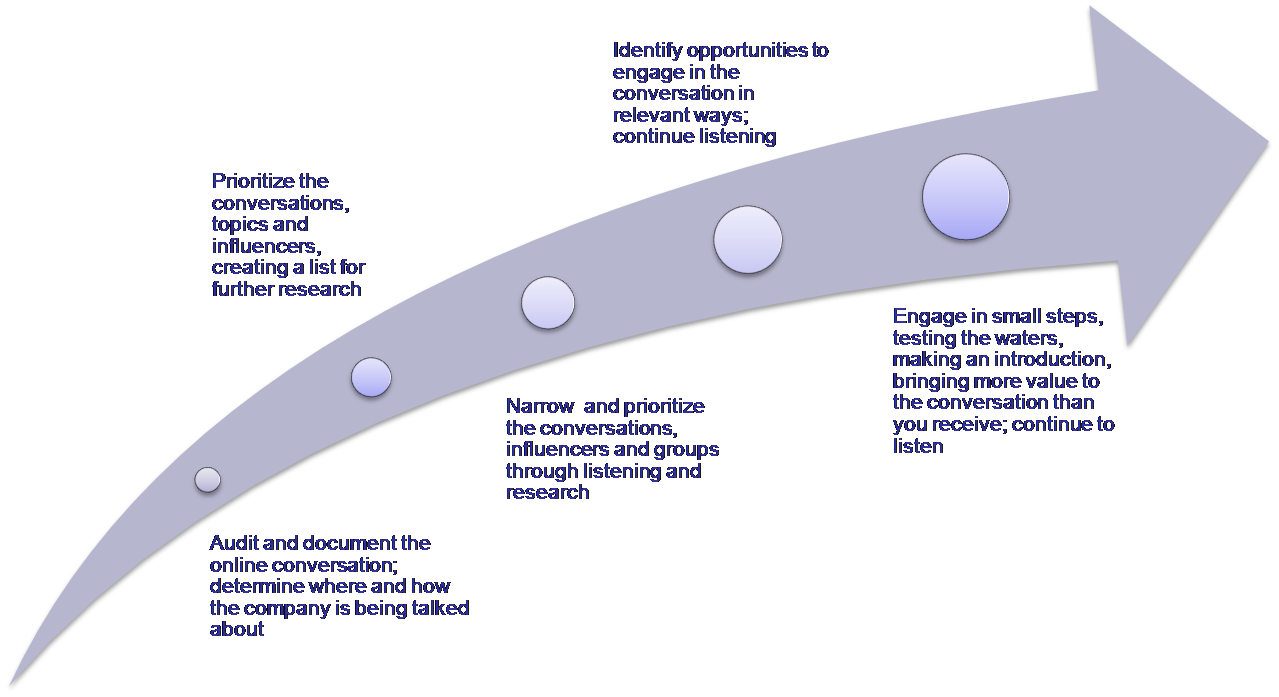
The diagram below outlines the listening process.  It’s shown in a linear format to provide context for listening on a longer continuum, but listening is part of a circular process that is ongoing and includes outreach and evaluation.

Are you listening?


listening-process2

Journalistic Integrity vs. Online Perspective

I was on a panel with two journalist recently. One led a progressive online outlet, the other worked for a traditional print publication with a growing online component.


We talked to a group about the obvious struggles that traditional media continue to have with the online medium.


Monetization issues aside, the journalist with the traditional paper brought up another issue that seems to be prevelant among traditional media.  He said that his publication gives its staff the ability to blog for the paper on its Web site but that when he does, he feels conflicted.  He’s concerned about blogging in a way that might cloud his writing for the print edition.


His main concern is that he wouldn’t want the opinions he expresses on his paper’s blog to somehow undermine the objectivity and balance that built his traditional journalistic background.


This conflict highlights an important pressure point in the ongoing struggle of traditional media and the online medium – fairness and balance are not exclusive of opinion and perspective.

The reason blogs are successful isn’t because they adhere to the conventions of journalistic integrity. Blogs are raw (although less so). Blogs incite emotion.

It’s that emotional response people have with blogs that keep readers coming back, responding in comments, and why blogs are so disruptive to traditional media who will continue to wrestle with that format.


Personally, I don’t expect the blogs I read to be balanced.  That’s why I go to blogs – for an opinion.  I like having something to react to and challenge my thinking.  Do I expect that opinion expressed on the blogs I read to be educated based on the collective insight gained by looking at all of the opinions – definitely.


Back to my traditional journalist’s conundrum. I told him I thought he would better servce his readers by blogging more and expressing his point of view on topics in a way that will lead the reader to greater meaning that they may not have been able to find otherwise.

Becuse exposure to new thinking, new people and new ideas is where the real value of the Interent resides.


The Truth is … We Don’t Know

A few years ago, I was in a room with knowledgeable cell phone chip engineers and marketers. They were pouring over data that definitively said that consumers would never want their cell phones to do anything other than conduct voice calls. Fast forward to today, and you can see how wrong that thinking and “data” was.

A post today on ReadWriteWeb highlighted recent data that claims the use of mobile social networks will barely go beyond today’s major players.  From the ABI Research study …

According to a recent online survey* conducted by ABI Research, nearly half (46%) of those who use social networks have also visited a social network through a mobile phone. Of these, nearly 70% have visited MySpace and another 67% had visited Facebook. No other social networking site reached 15% adoption mobile adoption.”

While I don’t question the themes and undertones of the findings at this particular point in the mobile social era, to try to determine how receptive consumers will be to other mobile social networks and how they will use them at this stage is like trying to call who will win the World Series from the first pitch on opening day.

To see the bigger picture, you have to look at the way networks form, consider geosocial patterns around the world (which are behind the US market in many respects) and understand that social is still the great experiment.

No one knows what is going to happen. But, with the speed at which the space is moving, we’ll know more soon enough.

Blasts from the Past – Like a Tech Yearbook, Complete with Prom Pics

I found a link on Twitter to the Google archives from 2001. 

In honor of our 10th birthday, we’ve brought back our oldest available index. Take a look back at Google in January 2001.” – Google

While checking out the life and times of my 2001 self, I remembered another fun Web research tool, Web Archive, that lets you search for Web pages back to 1996. 

I was surprised to see that many of the links on the pages were still clickable.  I’m sure others with the understanding of the architecture may not be as impressed. But, the fact that I was almost able to build a 1999 Escort on the Ford site was pretty cool.

I’ve included a few interesting searches below, but take a look for yourself.  One of the more interesting finds is the search I did for Technorati.  Looking at the Technorati homepage from 2002 indicates that the site on that day was tracking 15,729 blogs.  It’s little things like that stat which offer insight to to the growth of the Internet.

Take a look, and let me know if you find anything interesting.

Technorati: Dec 09, 2002

MIT Blogdex Top 10

Gizmodo: Aug 24, 2002

Engadget: Mar 05, 2004

GigaOm: Dec 02, 2001

CNN.com: Jun 20, 2000

Scobleizer: Dec 14, 2005

Chevrolet.com: Mar 03, 2000

Ford.com:Mar 03, 2000 

Pepsi.com: Dec 19, 1996 

AOL.com: Dec 20, 1996

Netscape.com: Oct 20, 1996